

Weak or poorly coordinated hip muscles can contribute to lower back pain by changing how the pelvis and trunk handle walking, stairs, lifting, and standing. However, hip weakness is only one possible factor. Disc, joint, nerve, and other conditions can produce similar symptoms, so an evaluation is more useful than assuming a few strengthening exercises will solve the problem.
The hips and lower back work together during almost every daily movement. When one area becomes painful or less active, the other may compensate. That relationship can create a cycle of reduced activity, fatigue, and recurring discomfort.
How do the hips support the lower back?
Muscles around the hips help control the pelvis when you walk, climb stairs, stand on one leg, or rise from a chair. They also contribute during lifting and carrying. If the pelvis moves excessively or the hips do not share the load well, the trunk muscles may work harder to maintain balance.
The gluteal muscles are often discussed, but hip flexors, rotators, adductors, and the surrounding trunk muscles all participate. Strength alone is not the whole story. Timing, endurance, mobility, and confidence in the movement also matter.
What daily signs may suggest the hips are involved?
Possible signs include difficulty climbing stairs, pushing up from a low chair, balancing on one leg, or walking uphill. You may notice the knee drifting inward during a step, the pelvis shifting to one side, or the trunk leaning when carrying weight.
These observations do not prove hip weakness is causing back pain. Pain itself can temporarily reduce muscle output, and nerve irritation may affect strength or coordination. A clinician can compare both sides and determine whether the finding is meaningful.
Can tight hips cause lower back pain?
Limited hip movement may lead a person to borrow motion from the lower back during bending, walking, or rotation. For example, if the hip does not extend comfortably, the lower back may arch more during a stride. If rotation is limited, the trunk may twist farther during sports or household tasks.
But “tightness” can describe muscle tension, joint restriction, nerve sensitivity, or simply a protective response to pain. Aggressive stretching is not automatically the answer and may aggravate symptoms in some people.
Do weak hips cause sciatica?
Hip weakness does not by itself establish the cause of sciatica. Sciatica involves symptoms along the sciatic nerve pathway and may be related to spinal nerve irritation or other conditions. Weakness in the leg can also be a result of nerve involvement rather than its cause.
If the foot begins to drag, the leg gives way, or strength is progressively declining, seek an evaluation promptly. Exercises chosen without understanding the source may delay appropriate care.
Which movements can reveal hip-control problems?
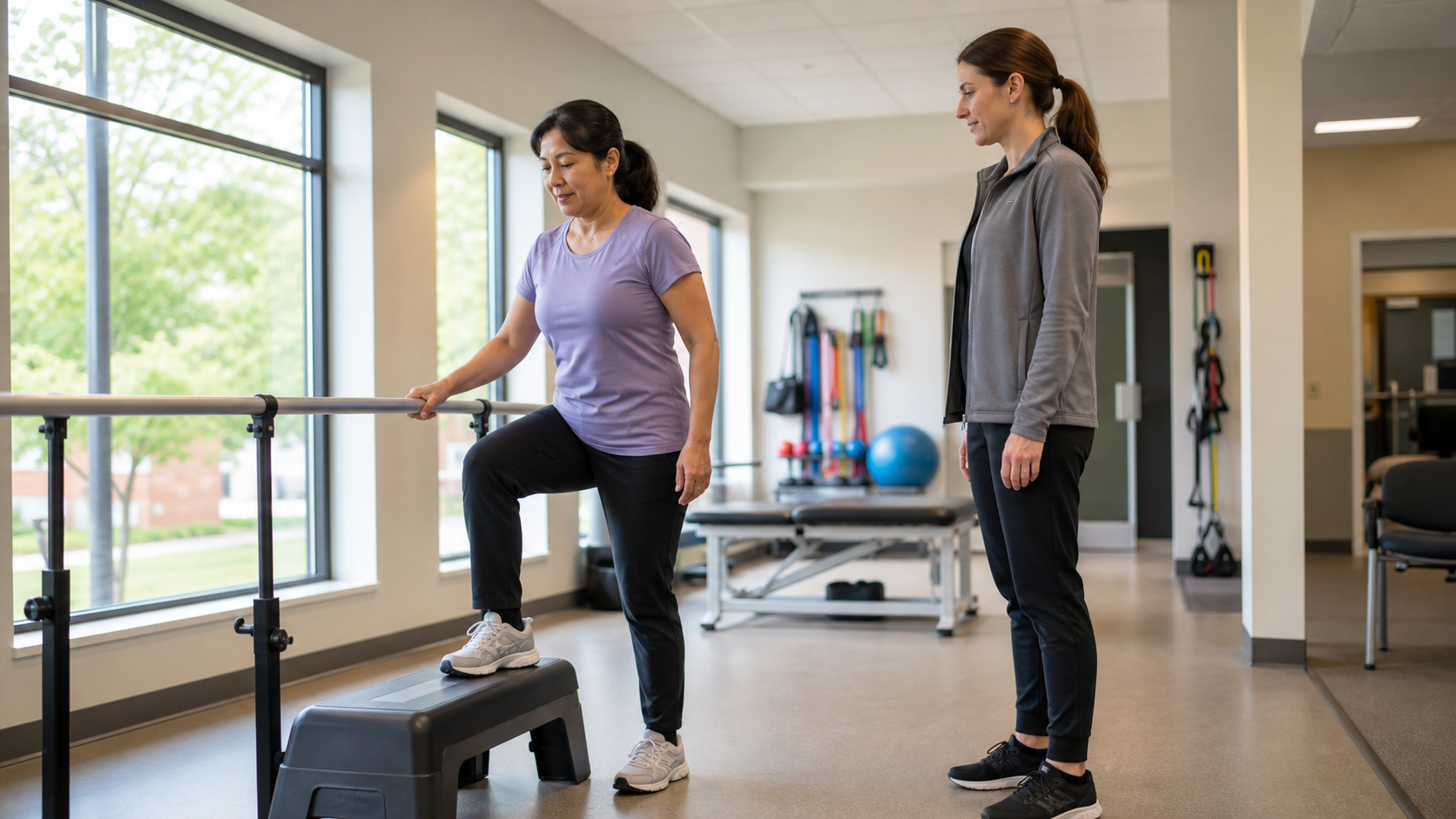
Clinicians may observe walking, a sit-to-stand movement, a low step-up, or a supported single-leg stance. They may also test strength and range of motion while noting whether the activity changes back or leg symptoms.
These are assessments, not competitions. A person should not repeatedly perform a painful squat or balance test at home to prove weakness. The quality of movement and symptom response are more important than how many repetitions can be completed.
Can hip strengthening reduce back pain?
Hip strengthening may be one helpful part of a broader rehabilitation plan, especially when an evaluation identifies reduced strength or endurance. Programs often begin with controlled, low-load movements and progress toward tasks such as stairs, lifting, or walking.
Results vary because lower back pain has many causes. Strengthening should not sharply increase back pain or send symptoms farther down the leg. If that happens, stop and ask a qualified professional to reassess the exercise.
What are safer ways to begin?
Start with activities you already tolerate, such as short walks or repeated sit-to-stand movements from an appropriate chair. A clinician may add exercises such as a supported bridge, side step, or low step-up, but the selection and dosage should match your findings.
Use a stable surface for support, move slowly, and avoid holding your breath. Increase only one variable at a time—repetitions, resistance, or range—so you can tell how the body responds later that day and the following morning.
What practical habits support hip and back function?
- Change positions regularly instead of sitting for long periods.
- Use both legs evenly when rising from a chair.
- Take shorter walks and build duration gradually.
- Use a handrail when stairs feel unsteady.
- Keep loads close to the body and avoid twisting while carrying.
- Stop if leg numbness or weakness increases.
When should lower back pain be evaluated?
Arrange an evaluation when pain repeatedly limits walking, stairs, sleep, or work; persists beyond several days; or is accompanied by leg symptoms. An examination can help determine whether the hips are contributing or whether a disc, joint, nerve, or another source is more likely.
Seek urgent medical care for new bowel or bladder changes, numbness in the saddle area, rapidly worsening weakness, fever with severe back pain, or symptoms after a significant injury.
Depending on the findings, care may include activity guidance, rehabilitation, or discussion of non-surgical spinal decompression for selected disc-related conditions. Spinal decompression does not directly strengthen the hips and is not appropriate for every type of back pain.
Get a personalized evaluation in Buffalo Grove
If hip fatigue, stairs, walking, or lifting repeatedly triggers back or leg symptoms, Dr. Daniel Satinsky and the Chicago Disc Center team can evaluate the pattern and discuss appropriate next steps. Call 847-227-8427 to arrange a consultation at the Buffalo Grove office.
Frequently asked questions
Are squats always good for lower back pain?
No. Squats can be useful when appropriately selected and performed, but depth, load, and technique should match your condition and current tolerance.
Can one hip be weaker than the other?
Yes, side-to-side differences are common. A clinician can determine whether the difference is significant and whether pain or nerve symptoms are affecting the test.
Will spinal decompression fix hip weakness?
No. Spinal decompression may be considered for selected disc-related conditions, while hip weakness generally requires an appropriate movement or strengthening plan.



Comments are closed.